December 29, 2025
 763 Views
Best way to connect Salesforce and Jira without custom code


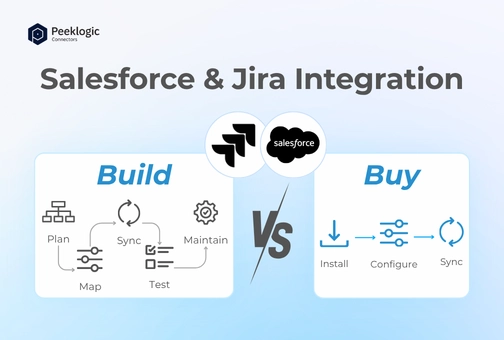
Salesforce is used by a lot of companies to keep track of customer information, sales pipelines, and support cases. Some people use Jira to keep track of bugs, development tasks, or project workflows. It is useful to connect these two platforms when teams from sales, support, and engineering need to work together. This integration is possible with a no-code or low-code connector, which doesn’t require a lot of custom development.
This article looks at how connecting Salesforce and Jira can make communication, process flow, and productivity better. We talk about what a no-code connector does, when it makes sense to use one, common problems to look out for, and how to set up integration in a way that is easy to maintain.
Some of the secondary keywords used throughout are: Salesforce Jira integration, no-code Salesforce Jira connector, CRM and issue tracker sync, Salesforce Jira synchronization, and Salesforce Jira use case.

Why should you combine Salesforce and Jira?
Salespeople or customer service representatives at many companies use Salesforce, while engineers or support staff keep track of their work in Jira. Without integration:
- Teams that deal with customers can’t see how development or support is going.
- Developers might not know everything about a customer’s history, priorities, or the value of their business.
- Manual handoffs and data duplication can make things take longer, make mistakes, or lose information.
When a sales rep or account manager makes a case, opportunity, or user request in Salesforce, a task or issue will also show up in Jira. This is made possible by connecting Salesforce and Jira. That way, both teams can share useful information and stay on the same page.
Companies that use both CRM and development/tracking tools together say they can solve problems faster, work together better, and have fewer misunderstandings. According to a study from 2023, cross-team visibility can cut down on rework and speed up delivery by as much as 30%. (Source: general industry reports on DevOps-to-business alignment, 2023)
What does a Salesforce–Jira connector with no code do?
A no-code (or low-code) connector connects Salesforce and Jira. The main things it does are:
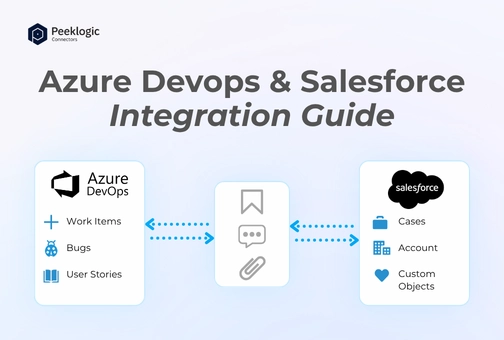
- Link Salesforce objects like Accounts, Opportunities, Cases, and Contacts to Jira issues like Tasks, Bugs, Projects, and Epics.
- Automatically sync data: when you create, change, or close a record in one system, the record in the other system updates to match.
- You can do field mapping, status mapping, and data transformations without writing any code.
- Keep track of synchronization history and use built-in logic and error handling to deal with conflicts or duplicates.
- Make it easy for admins to set up by giving them a web UI that is easy to use.
This method cuts down on the time it takes to set up, the cost of maintenance, and the need to create custom APIs.

Benefits of Connecting Salesforce and Jira Without Custom Code
There are a number of benefits to using a pre-made, no-code connector to connect Salesforce and Jira:
- Faster implementation: A prebuilt connector lets you skip long development cycles. This usually cuts down on the time it takes to go from planning to deployment.\
- Lower maintenance costs: Because there is no custom code, upgrades to Salesforce or Jira will usually keep working without having to be redone.
- Better teamwork across teams: Sales, support, and engineering all use the same data. Sales knows exactly when fixes or new features are sent out. Developers know what the business needs when they work on tasks.
- Better customer experience: Customer support can keep track of the status of development and delivery, talk to clients clearly, and avoid making mistakes by hand.
- Scalability and reliability: Connectors are tested on different versions, can handle edge cases like status changes and data conflicts, and can grow as the number of records grows.
This means that teams can start using integration early and grow safely without having to do a lot of custom development.
Common Problems and How a Connector Can Help You Solve Them
Linking CRM and issue tracking can be very useful, but it can also be hard. Some common problems are:
- The difficulty of mapping data. Salesforce and Jira store data in different ways. It can be hard to map fields like customer name, contact information, case details, and priority levels. A connector gives you the tools you need to map these relationships correctly.
- Alignment of status and workflow. For instance, a “Closed” case in Salesforce might be the same as a “Done” issue in Jira, but what about statuses in between? A connector lets you set up how statuses, transitions, and workflows are mapped.
- Managing duplication and conflicts. When both sides update their data, problems can happen. Good connectors help with finding duplicates and resolving conflicts.
- User rights and safety. It is very important to make sure that only authorized users can see or change synchronized data, especially in industries that are regulated. Connectors usually follow the rules for both Salesforce and Jira.
- Version compatibility and upgrades. When Salesforce or Jira updates, custom code might break. A maintained connector usually makes sure that it works with new versions of the platform.
Companies can avoid many of the problems that come with custom API-based integration by using a no-code solution. They can also take advantage of automation and data consistency.

Real-World Use Case: IT Support Workflow with Salesforce and Jira
When a No-Code Connector is the Best Option and When Custom Integration Might Still Be Necessary
A no-code Salesforce–Jira connector works well when:
- You need a pretty standard integration that includes cases or tasks going to issues, status syncing both ways, and basic field mapping.
- You want to be able to deploy quickly without needing developers.
- Your company cares about maintainability and wants to avoid having to do extra work when platforms are updated.
- The amount and complexity of the data are still moderate.
But if your company needs:
- Workflows that are very specific to your needs, complicated data changes, or custom objects/fields that go beyond the usual cases and issues.
- Deep automation that includes other systems, custom business logic, or complicated audit or compliance requirements.
- Data flows with very high volume and performance sensitivity, or custom events and triggers.
Then, it might still be necessary to use a custom integration, such as an API-based, middleware, or combined approach. The no-code connector gives you a solid foundation, and you can add custom work on top of it later if you need to.

Important Things to Think About Before Setting Up Salesforce–Jira Integration
Before you adopt a connector, ensure your team considers:
- What things and data need to be in sync (Cases, Accounts, Opportunities, custom objects) and how they relate to Jira issues.
- What workflows and statuses need to be mapped between Salesforce and Jira?
- User access and permission models: who can see or change data after it has been synced?
- The number of records and the expected flow of data to avoid performance problems.
- To catch sync problems or conflicts, there are procedures for maintenance, monitoring, and handling errors.
- Aligning stakeholders means making sure that the sales, support, and development teams all agree on the workflow, naming conventions, and priorities.
- Planning ahead and having clear workflows help avoid surprises and make sure that integration really adds value.
Key takeaways
You can get a lot of value out of connecting Salesforce and Jira without writing any custom code. For example, your teams can work together better, your workflows can go faster, there can be fewer mistakes, there can be more transparency, and your maintenance costs can go down. A no-code Salesforce–Jira connector is a practical way to keep your CRM and issue tracking systems in sync without a lot of coding work.
That being said, you should carefully think about what you need. For normal workflows and moderate complexity, a connector is often the best way to go. You might still need layered solutions or custom integration for processes that are very specific to your needs.
We can help you connect Salesforce to Jira or look into a no-code integration solution for your business. We know how to make secure, easy-to-maintain integrations that fit with your business processes.
If you’re looking into ways to connect Salesforce and Jira, read our other article for more information. Want to see how this works in real life? Get in touch with us to go over your needs and begin an integration based on connectors.


Salesforce Integration & Implementation | AppExchange and Custom Development | Data Migration
Contact us today!