December 07, 2025
 8 min
8 min  1133 Views
7 Ways to Integrate Salesforce and Azure DevOps


Discover 7 ways to integrate Salesforce and Azure with Peeklogic Connector. Streamline workflows, automate tasks, and boost productivity today.
Most organizations today use multiple cloud platforms, and getting them to work together can be a real headache. If you’re using both Salesforce for customer management and Azure DevOps for development work, you’ve probably wondered how to connect them effectively.
The good news is there are several approaches, each with its own pros and cons. Let’s walk through the most practical options.
1. Peeklogic Salesforce Azure DevOps Connector
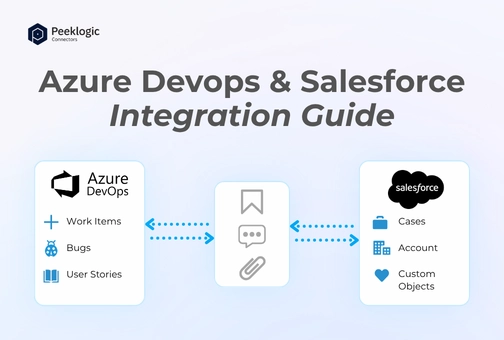
This is one of the newer integration tools on the market, and it’s designed specifically for Salesforce and Azure DevOps integration. What sets it apart is that you don’t need to write much (or any) code to get things working.
The setup is pretty straightforward – you can sync Salesforce records with Azure DevOps work items, and changes flow both ways. The tool includes templates for common scenarios, which saves time if you’re doing standard integrations.
One software company I know used this to connect their sales pipeline with their development backlog. Now when sales creates an opportunity, the dev team automatically gets work items created with the right details. It took them about a month to get everything working smoothly.
The main benefits:
- Quick setup compared to custom solutions
- Works in both directions
- Includes monitoring tools
- Handles most common integration patterns
2. Azure Active Directory Integration
If you’re already using Azure AD, this is probably your easiest starting point. You can set up single sign-on so your team only needs one login for both systems.
Beyond just convenience, this approach gives you centralized user management. When someone joins or leaves your team, you manage their access in one place instead of updating multiple systems.
A consulting company I worked with streamlined their onboarding this way. New developers get access to everything they need through one workflow, and when someone leaves, they can cut off access immediately across all platforms.
3. Azure Data Factory
This is your best bet if you need to move large amounts of data between systems or want to combine data from both platforms for reporting.
Data Factory works well when you need scheduled data transfers or want to transform data as it moves between systems. You can set up pipelines that run nightly to sync project data, or trigger transfers when specific events happen.
One company used this to combine customer feedback from Salesforce with bug reports using Azure DevOps. Now their product team can see which features customers want most and how those relate to development work.
4. Logic Apps for Automation
Logic Apps is Microsoft’s workflow tool, and it’s great for automating processes that span both platforms. The visual interface makes it accessible even if you’re not a developer.
Some common scenarios:
- Create Azure DevOps tasks when support cases come in through Salesforce
- Update sales opportunities when development milestones are hit
- Send notifications to sales teams when builds complete
A healthcare software company automated their feature request process this way. When sales logs a customer request in Salesforce, Logic Apps creates the work items in Azure DevOps and estimates timelines based on team capacity.
5. Custom Azure Functions
When you need something more specialized, Azure Functions let you write custom code that runs in the cloud. This approach works well for complex business rules or unique data transformations.
You’ll need some development skills for this option, but it gives you complete flexibility. Functions can respond to events from either platform and implement whatever logic your business requires.
A financial software company built functions that analyze development patterns and predict project timelines. Their sales team now gives customers more accurate estimates during negotiations.
6. Power BI for Reporting
If you mainly need better visibility into both platforms, Power BI can connect to both Salesforce and Azure DevOps to create unified dashboards.
This works particularly well for executives who want to see how sales pipeline relates to development capacity, or for project managers tracking delivery timelines against customer expectations.
You can build dashboards that show:
- Sales forecasts with development capacity
- Customer satisfaction vs. bug resolution rates
- Resource allocation across sales and development
7. Azure API Management
For larger organizations with multiple custom applications, API Management provides a centralized way to manage access to both platforms.
This approach is overkill for simple integrations, but valuable if you have several applications that need data from both systems. You get consistent security, monitoring, and documentation across all your APIs.
Which Approach Should You Choose?
Your best option depends on what you’re trying to accomplish:
- Quick, standard integrations: Try Peeklogic or Logic Apps first
- User management: Start with Azure AD integration
- Large-scale data movement: Use Data Factory
- Custom business logic: Build Azure Functions
- Reporting and analytics: Connect Power BI to both platforms
- Enterprise API governance: Consider API Management
Most organizations end up using a combination of these approaches rather than picking just one. Start with the simplest solution that meets your immediate needs, then add complexity as your requirements grow.
The key is to avoid over-engineering your initial integration. Get something working that solves your biggest pain points, then iterate from there.
Ready to transform your Salesforce and Azure DevOps integration?
Contact the Peeklogic team today to discover how our advanced connector can streamline your development workflows and enhance cross-platform collaboration.
See Peeklogic in Action
Learn moreKey takeaways
Salesforce Azure integration helps businesses connect CRM data with cloud services, analytics, applications and development workflows. When Salesforce and Microsoft Azure work together, teams can improve data exchange, automate routine processes and support more reliable system communication. With the right integration setup, companies can reduce manual work, strengthen visibility across platforms and build a more connected digital environment.
Frequently Asked Questions
Connecting these platforms streamlines collaboration between sales and development teams so work moves faster with fewer manual steps.
It offers quick setup, two-way syncing, and ready-made templates that remove the complexity of custom development work.
Focus on your goals — automation, reporting, user management, or custom logic — and start with the simplest solution that solves your immediate challenges.


Salesforce Integration & Implementation | AppExchange and Custom Development | Data Migration
Contact us today!