November 18, 2025
 15 min
  707 Views
Salesforce Service Cloud and Azure DevOps Integration: Connecting Customer Service with Development Lifecycle


Salesforce Service Cloud and Azure DevOps integration transforms customer feedback into development action.
Introduction
Salesforce Service Cloud and Azure DevOps integration establishes a critical connection between customer support and development teams. Organizations managing these platforms separately struggle with delayed issue resolution, lost customer insights, and misaligned priorities. Peeklogic Connector for Salesforce and Azure DevOps eliminates these challenges by creating a streamlined information flow that converts customer feedback into development tasks while maintaining transparency throughout the resolution process.
Platform Descriptions
Salesforce Service Cloud
Salesforce Service Cloud functions as a comprehensive customer service platform that centralizes case management, omnichannel support, and customer engagement. It provides organizations with tools to capture, route, and resolve customer inquiries while maintaining detailed interaction histories. The platform excels at automating support workflows, managing service level agreements, and delivering personalized customer experiences across multiple communication channels.
Azure DevOps
Azure DevOps serves as Microsoft’s end-to-end software development platform that combines version control, agile planning, continuous integration, and deployment automation. It enables development teams to plan sprints, track work items, manage code repositories, automate builds, and orchestrate releases. Azure DevOps provides the structure and tools necessary for implementing DevOps practices while supporting diverse development methodologies from traditional waterfall to advanced CI/CD pipelines.
Peeklogic Connector Introduction
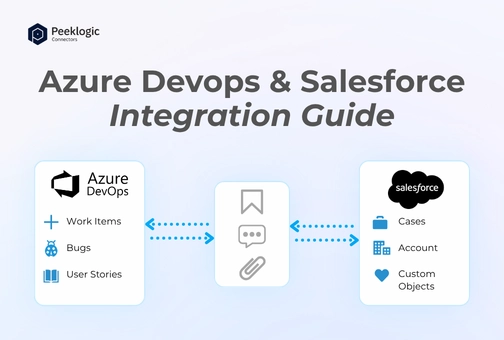
Peeklogic Connector for Salesforce Service Cloud and Azure DevOps establishes an intelligent bridge between customer support and development environments. This specialized integration solution automatically synchronizes relevant cases with Azure DevOps work items, maintaining bi-directional updates throughout the resolution lifecycle. The connector transforms customer feedback into actionable development tasks without manual transfers, custom coding, or security compromises.
Integration Benefits
The integration delivers substantial advantages that transform service and development operations:
- Customer-Driven Development: Customer feedback captured in Salesforce directly influences development priorities in Azure DevOps, ensuring products evolve based on actual user needs.
- Transparent Issue Tracking: Support teams gain visibility into development progress without accessing development tools, enabling accurate status updates to customers.
- Accelerated Defect Resolution: Bug reports flow automatically from customer service to development backlogs, eliminating handoff delays and reducing time-to-fix by up to 35%.
- Closed Feedback Loop: Completed fixes trigger automatic notifications back to customer service, allowing proactive outreach to affected customers.
- Enhanced Root Cause Analysis: Developers receive complete customer context including environment details, steps to reproduce, and impact assessments directly from service cases.
See Peeklogic in Action
Learn moreConnector Features
Peeklogic Connector offers essential technical capabilities that ensure reliable platform integration:
- Intelligent Work Item Creation: Automatically generates appropriate Azure DevOps work items (bugs, user stories, tasks) based on case categorization in Salesforce.
- Customizable Field Mapping: Flexible field mapping accommodates organization-specific terminology and data requirements across both platforms.
- Sprint and Release Association: Links customer cases with specific development sprints and releases for prioritization and planning purposes.
- Bi-Directional Updates: Changes to status, priority, or comments in either system automatically reflect in the connected platform.
- Attachment Synchronization: Screenshots, logs, and other diagnostic files transfer seamlessly between platforms, providing developers with essential troubleshooting data.
- Custom Query Support: Creates filtered synchronization rules based on case characteristics to ensure only relevant issues reach development teams.
- Reporting Integration: Combines service metrics with development statistics to create comprehensive dashboards spanning customer impact to resolution time.
Business Benefits
Organizations implementing this integration realize measurable outcomes:
- Reduced Development Cycles: Companies report 20-30% shorter development cycles through better prioritization of customer-impacting issues.
- Higher Customer Satisfaction: Direct connection between customer feedback and product improvements leads to documented increases in satisfaction scores.
- Improved First Contact Resolution: With visibility into known issues and development status, agents resolve 15-25% more cases during initial contact.
- More Effective Resource Allocation: Clear visibility into customer impact helps development teams allocate resources to issues with the highest business value.
- Enhanced Product Quality: Systematic capture and prioritization of customer-reported issues results in more stable releases and fewer recurring problems.
- Streamlined Communication: Elimination of manual updates between teams reduces miscommunication and ensures consistency in customer messaging.
Implementation Steps
Implementing the Peeklogic Connector involves five straightforward steps:
- Requirements Analysis: Identify integration objectives, determine which case types should synchronize with development, and establish data mapping requirements.
- Platform Preparation: Configure necessary authentication credentials, API access, and security permissions in both Salesforce Service Cloud and Azure DevOps.
- Connector Configuration: Install the Peeklogic Connector and establish field mappings, synchronization rules, and workflow triggers between platforms.
- Validation Testing: Conduct thorough testing with various case scenarios to ensure accurate data transfer, proper work item creation, and status synchronization.
- Team Onboarding: Train customer service and development teams on the integrated workflow, reporting capabilities, and best practices for cross-platform collaboration.
Best Practices
Follow these recommendations to maximize integration success:
- Standardize Classification Systems: Align case categories in Salesforce with work item types in Azure DevOps to ensure consistent routing and reporting.
- Implement Clear Escalation Criteria: Define specific thresholds that determine when customer issues warrant development involvement to prevent overwhelming development backlogs.
- Establish SLA Alignment: Ensure service level agreements in Salesforce align with development response expectations in Azure DevOps.
- Create Cross-Team Visibility: Develop dashboards that display integrated metrics to foster shared ownership of customer issues.
- Regularly Review Integration Rules: Schedule quarterly assessments of synchronization rules to adapt to changing business requirements and identify optimization opportunities.
Use Cases
Bug Management Lifecycle
When customers report software defects through Salesforce Service Cloud, the integration automatically creates corresponding bug work items in Azure DevOps with complete reproduction steps and environmental context. Developers update status and add technical notes as they investigate and fix the issue, with these updates reflecting back to service agents in Salesforce. Upon deployment, the case automatically updates with resolution details, enabling proactive customer notification.
Feature Request Prioritization
Customer feature requests captured in Salesforce Service Cloud synchronize to Azure DevOps as user stories or feature work items. Product managers gain visibility into request frequency and business impact, helping prioritize development backlogs based on customer demand. As features progress through development stages, customers receive automatic updates through service agents, strengthening engagement and demonstrating responsiveness to feedback.
Release Impact Assessment
The integration enables customer service teams to view upcoming releases and associated fixes directly in Salesforce. Agents identify which customers will benefit from specific releases, allowing targeted communication about improvements. This preparation reduces support volume during release transitions and creates opportunities for positive customer outreach.
Technical Escalation Workflow
When complex technical issues require developer expertise, the integration facilitates a structured escalation process. Cases meeting predefined criteria automatically generate Azure DevOps tasks assigned to appropriate technical specialists. This maintains accountability through the escalation process while preserving all customer context, resulting in faster technical resolutions and consistent communication.
Key Takeaways
Salesforce Service Cloud and Azure DevOps integration through Peeklogic Connector transforms traditionally separate customer service and development functions into a cohesive feedback-driven process. By establishing direct connections between customer experiences and development activities, organizations create more responsive products, accelerate issue resolution, and deliver higher quality customer service. This strategic integration positions companies to turn customer feedback into a competitive advantage through systematic product improvement.
- Peeklogic Connector establishes seamless data flow between Salesforce Service Cloud and Azure DevOps
- Integration reduces defect resolution time by up to 35% through automated handoffs and rich context sharing
- Customer feedback directly influences development priorities, creating more customer-centric products
- Bi-directional updates maintain consistency between customer service promises and development reality
- Implementation follows a structured five-step process requiring minimal technical complexity.
Ready to Transform Your Customer Feedback Loop?
Contact the Peeklogic team today to learn how our Salesforce Service Cloud and Azure DevOps integration can enhance your development responsiveness.
Frequently Asked Questions
Most connectors can be installed and configured in just a few minutes. We also provide clear documentation and support to make the process seamless.
Most connectors can be installed and configured in just a few minutes. We also provide clear documentation and support to make the process seamless.
Most connectors can be installed and configured in just a few minutes. We also provide clear documentation and support to make the process seamless.
Most connectors can be installed and configured in just a few minutes. We also provide clear documentation and support to make the process seamless.


Salesforce Integration & Implementation | AppExchange and Custom Development | Data Migration
Contact us today!