January 29, 2026
 8 min
8 min  2488 Views
Salesforce vs ServiceNow: Which Platform Fits Your Business Best in 2026?


When businesses assess enterprise platforms for automation and digital transformation, the choice frequently boils down to Salesforce or ServiceNow. Both are robust cloud ecosystems, yet they address distinct business challenges.
ServiceNow is primarily an ITSM and service management platform designed to optimize internal service operations, workflows, and compliance. Salesforce is the world’s leading CRM platform focused on customer relationships, sales process optimization, and customer experience across marketing, sales, and support.
Understanding how ServiceNow vs Salesforce differs helps organizations choose the right foundation — or decide how to integrate both platforms for end-to-end automation.
Salesforce vs ServiceNow: Feature Comparison
Workflow Automation and Low-Code Tools
Both platforms support low-code workflow automation. ServiceNow specializes in structured process automation for approvals, incidents, and service delivery. Salesforce focuses on automating sales flows, case routing, customer onboarding, and campaign execution.
Organizations choosing between service now vs salesforce should evaluate whether their automation priorities are internal service operations or customer-facing processes.
Analytics, Dashboards, and Visibility
ServiceNow dashboards emphasize operational health, ticket resolution performance, SLA compliance, and service delivery metrics. Salesforce analytics provide deep insight into pipeline performance, conversion rates, customer engagement, and forecasting.
Both platforms support real-time reporting and customizable dashboards, but they serve different audiences and business goals.
AI and Generative Automation
Salesforce integrates AI through Einstein and generative AI features to support forecasting, personalization, and automated content generation. ServiceNow applies AI-driven automation with Virtual Agents, predictive routing, and AIOps to improve service operations and reduce manual workload.
AI capabilities increasingly influence how organizations automate workflows and improve efficiency across both ecosystems.
Integration and Ecosystem Connectivity
Salesforce integrates with marketing tools, payment platforms, analytics systems, and SaaS ecosystems. ServiceNow connects with monitoring systems, identity platforms, enterprise ERP tools, and security systems.
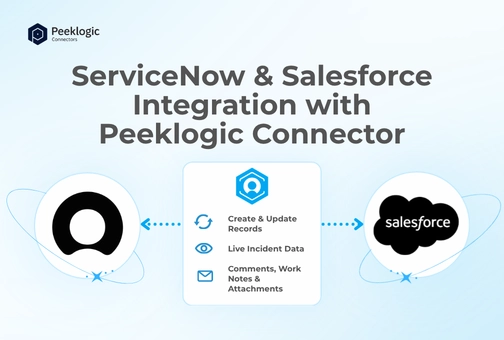
For many organizations, salesforce and servicenow integration enables seamless data flow between customer-facing teams and internal service operations. APIs, middleware platforms, and connectors support bidirectional synchronization.
Service Cloud vs ServiceNow: Customer Support Perspective
When comparing Salesforce Service Cloud vs ServiceNow, the difference lies in audience and workflow orientation.
Service Cloud focuses on omnichannel case management, customer engagement, knowledge base management, and field service workflows. It is optimized for external customer support and relationship building.
ServiceNow focuses on internal incident management, ITSM processes, and service operations governance. It excels at handling internal service requests, asset dependencies, and compliance-driven workflows.
Pricing, Scalability, and Total Cost
Salesforce pricing is modular across Sales Cloud, Service Cloud, and add-ons. Licensing scales with users and advanced functionality. It suits organizations focused on revenue growth and customer experience optimization.
ServiceNow uses enterprise licensing based on modules and user roles. It delivers strong ROI for organizations that require comprehensive ITSM and service automation at scale.
Cost decisions often reflect whether the organization prioritizes customer operations or internal service delivery.
Platform Purpose and Core Use Cases
What Salesforce Is Built For
Salesforce is a cloud CRM ecosystem focused on managing customer relationships and revenue growth. It centralizes sales pipelines, customer interactions, marketing campaigns, and case management across Sales Cloud, Service Cloud, and industry solutions such as Field Service Management.
Salesforce helps businesses improve customer engagement, optimize sales processes, and deliver consistent customer service management experiences. With built-in analytics, AI-driven insights, and workflow automation, Salesforce enables organizations to scale customer operations efficiently.
In short, ServiceNow is best for internal service operations and ITSM, while Salesforce excels in external customer relationship management and growth.
What ServiceNow Is Built For
ServiceNow is designed to manage internal service delivery at scale. It supports IT service management (ITSM), HR service management, security operations, and enterprise workflow automation. Organizations use ServiceNow to automate incidents, change management, approvals, asset tracking, and self-service portals using structured service management processes.
ServiceNow provides strong governance, compliance controls, and low-code tools to automate workflows across service operations. For enterprises that manage complex internal environments, ServiceNow offers a stable foundation for operational reliability and process optimization.
When to Choose ServiceNow, Salesforce — or Both
Choose ServiceNow if your business needs:
- ITSM, incident management, and service operations automation.
- Strong compliance, governance, and workflow control.
- Scalable service management processes for large internal teams.
Choose Salesforce if your business needs:
- CRM, sales automation, and customer engagement optimization.
- Advanced analytics and AI-driven customer insights.
- Omnichannel case management and field service management.
Use Salesforce and ServiceNow Together if you need:
- Visibility between customer cases and internal incidents.
- Automated routing of service requests across platforms.
- End-to-end workflow integration across the enterprise ecosystem.
The typical scenario would be if a client submits a support case in Salesforce Service Cloud. The issue is automatically pushed to ServiceNow as an internal incident for resolution. Updates synchronize back to Salesforce so customer-facing teams maintain visibility and service continuity.
Salesforce vs ServiceNow in 2026: Market Reality
In 2026, organizations evaluate platforms not only on functionality but also on ecosystem maturity, AI readiness, integration flexibility, and long-term scalability. Salesforce continues to expand generative AI and customer analytics capabilities. ServiceNow continues to strengthen enterprise automation, service operations intelligence, and workflow orchestration.
User adoption trends show Salesforce dominating CRM and customer experience platforms, while ServiceNow leads enterprise ITSM and service management domains.
Key takeaways
The Salesforce vs ServiceNow decision is not about choosing a better platform — it is about selecting the right platform for your business needs. Salesforce excels in customer relationship management, sales optimization, and customer engagement. ServiceNow excels in ITSM, internal workflow automation, and enterprise service operations.
Organizations focused on revenue growth and customer experience typically choose Salesforce. Organizations focused on operational stability and service delivery typically choose ServiceNow. Many mature enterprises integrate both platforms to streamline workflows and connect internal and external processes.
Frequently Asked Questions
No. ServiceNow does not provide full CRM functionality such as pipeline management and marketing automation.
Salesforce can handle customer case management but is not designed for full ITSM processes like ServiceNow.
Yes. APIs and middleware platforms enable data synchronization and workflow automation between both systems.
Both scale well, but ServiceNow is optimized for internal service operations, while Salesforce scales for customer-facing growth.
Yes. Both platforms use AI-driven automation to optimize workflows, analytics, and service delivery.


Salesforce Integration & Implementation | AppExchange and Custom Development | Data Migration
Contact us today!