November 18, 2025
 10 min
  468 Views
Navigating Remote Collaboration Challenges: How Salesforce-Jira Integration Supports Distributed Teams in 2025


Salesforce-Jira real-time synchronization bridges remote team gaps between customer management and development.
Salesforce-Jira integration transforms how distributed teams manage customer relationships and development workflows simultaneously. With remote work becoming permanent for many organizations, this integration bridges critical communication gaps between customer-facing and technical teams.
Platform Descriptions
Salesforce
Salesforce operates as the central hub for customer relationship management (CRM), enabling organizations to track interactions, manage sales pipelines, and deliver personalized customer experiences. The platform consolidates customer data, communications history, and business opportunities in a single interface accessible to team members regardless of location.
Jira
Jira serves as the backbone for agile development teams, providing structured project management capabilities through customizable workflows, issue tracking, and sprint planning tools. Development teams rely on Jira to organize tasks, track progress, and maintain visibility across complex technical projects.
Peeklogic Connector Introduction
The Peeklogic Salesforce-Jira Connector establishes a bidirectional data pipeline between these essential platforms. This integration synchronizes customer requirements, bug reports, and feature requests without requiring manual transfers between systems. The connector maintains data integrity across platforms while respecting each system’s security parameters and governance requirements.
Integration Benefits
Connecting Salesforce and Jira addresses the fundamental challenge remote teams face: maintaining alignment between customer needs and development priorities. This integration:
- Eliminates information silos between customer-facing teams and development departments
- Reduces context switching for team members who previously navigated between platforms
- Preserves data accuracy by synchronizing updates automatically across systems
- Creates transparency in how customer requests translate to development tasks
- Accelerates response times by streamlining the customer request-to-implementation cycle
Connector Features
The Peeklogic Salesforce-Jira Connector delivers technical capabilities essential for distributed team coordination:
- Real-time bidirectional synchronization ensuring both platforms reflect current information
- Field-level mapping allowing organizations to define exactly which data elements transfer between systems
- Configurable workflows that automatically create Jira tickets from Salesforce cases based on predefined rules
- Attachment sharing enabling technical documentation, screenshots, and files to move seamlessly between platforms
- Status tracking that updates Salesforce when development milestones are reached in Jira
- Custom object support for organizations with specialized Salesforce implementations
- Robust error handling with notification systems to address synchronization issues promptly
Business Benefits
Organizations implementing the Salesforce-Jira integration through Peeklogic experience tangible outcomes that directly impact distributed team effectiveness:
Enhanced Cross-Department Visibility
Sales representatives can provide accurate development timelines to customers without interrupting development teams. Meanwhile, developers gain context about customer impact when prioritizing their work.
Reduced Communication Overhead
The integration eliminates redundant status meetings and email chains, reducing the administrative burden that often plagues remote teams. This reclaimed time translates to increased productivity across departments.
Accelerated Development Cycles
With requirements flowing directly from customer interactions to development queues, teams can reduce project initiation time by 30-40%. This acceleration shortens time-to-market for critical features and bug fixes.
Improved Customer Satisfaction
Customers receive more accurate updates on their requests as the integration maintains current status information in Salesforce based on actual development progress. This transparency builds trust and improves customer retention.
Data-Driven Decision Making
The integrated systems generate comprehensive metrics on how effectively customer requests translate to delivered solutions, enabling leadership to identify process bottlenecks even in remote environments.
See Peeklogic in Action
Learn moreImplementation Steps
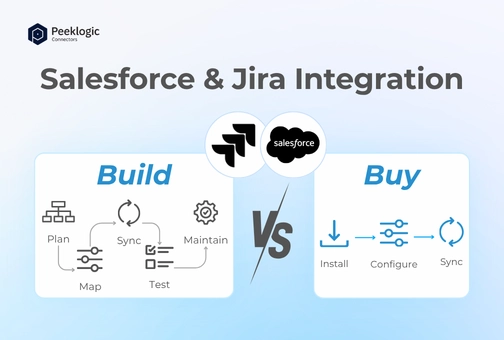
Implementing the Peeklogic Salesforce-Jira Connector follows a structured five-step process:
1. Discovery and Mapping
- Document existing workflows between customer service and development teams
- Identify critical data points that must synchronize between platforms
- Define permission structures and access requirements
2. Connector Configuration
- Install the Peeklogic Connector in both environments
- Configure authentication and secure API connections
- Establish field mappings based on organizational requirements
3. Workflow Development
- Create automation rules determining when Salesforce cases generate Jira tickets
- Define bidirectional status update protocols
- Implement notification systems for key events
4. Testing and Validation
- Verify data integrity across platforms
- Validate workflow triggers in controlled environments
- Measure synchronization performance under various conditions
5. Team Onboarding
- Provide role-specific training for sales, service, and development teams
- Document new procedures for cross-platform operations
- Establish support channels for troubleshooting
Best Practices
Organizations achieve optimal results from Salesforce-Jira integration by following these recommendations:
Standardize Classification Systems
Develop consistent terminology for categorizing customer requests in Salesforce that translates meaningfully to Jira issue types and priorities. This standardization ensures proper routing and prioritization across distributed teams.
Implement Progressive Field Mapping
Begin with essential fields that provide core functionality, then expand the integration scope based on team feedback and demonstrated value. This approach prevents overwhelming users with complex changes.
Create Clear Ownership Boundaries
Define which team members have authority to modify synchronized records in each system to prevent conflicts. This governance becomes particularly important in remote environments where communication happens asynchronously.
Establish Comprehensive Monitoring
Implement dashboards that track synchronization health, allowing administrators to identify and resolve connectivity issues before they impact team productivity.
Develop Cross-Platform Training
Ensure team members understand how their actions in one system affect data in the other, creating accountability across the integrated environment even when teams work remotely.
Key Takeaways
Salesforce-Jira integration through Peeklogic delivers the connection distributed teams need between customer management and development activities. By creating a seamless information flow between these critical platforms, organizations can maintain collaboration effectiveness regardless of physical location. The result is faster development cycles, improved customer satisfaction, and reduced operational friction in remote work environments.
- Salesforce-Jira integration eliminates information gaps between customer-facing and technical teams in distributed environments
- Bidirectional synchronization ensures both platforms maintain current, accurate information without manual intervention
- Automated workflows reduce administrative overhead that typically burdens remote collaboration
- Comprehensive visibility across platforms enables more accurate customer communications about development timelines
- Integrated metrics provide insights into process effectiveness even when teams operate in different locations
Transform Your Remote Team’s Collaboration Today
Connect your distributed teams with the Peeklogic Salesforce-Jira Connector. Schedule a consultation to discover how real-time synchronization between your customer data and development workflows can eliminate remote work barriers.
Frequently Asked Questions
Most connectors can be installed and configured in just a few minutes. We also provide clear documentation and support to make the process seamless.
Most connectors can be installed and configured in just a few minutes. We also provide clear documentation and support to make the process seamless.
Most connectors can be installed and configured in just a few minutes. We also provide clear documentation and support to make the process seamless.
Most connectors can be installed and configured in just a few minutes. We also provide clear documentation and support to make the process seamless.


Salesforce Integration & Implementation | AppExchange and Custom Development | Data Migration
Contact us today!